
tech level ball valves Low pressure

CONSTRUCTION
— Reformulated Version
Ball valves
(BV series) feature a body and sleeve manufactured from hot‑forged brass UNI EN
12420 – CW617N, while the connections are made from copper tubing EN 12735‑1 –
Cu‑DHP. The spindle, engineered to eliminate any risk of expulsion, is produced
from treated steel, and the corresponding pin is made of stainless steel. Body
and sleeve are assembled through a threaded joint and subsequently welded. HNBR
sealing rings positioned on the operating spindle ensure complete hermetic
isolation from the external environment.
The ball‑seat
gaskets, made from special modified PTFE, provide low operating torque and
guarantee zero seat leakage even under pressure differentials significantly
higher than the design PS. When the ball is in the closed position, an internal
self‑balancing of pressures is achieved, preventing unwanted stress on internal
components that could compromise product performance.
An access
port equipped with a Schrader valve can be supplied by adding –A– to the
product code (BV..A PLUS, BV..A, BV..AHC). For most sizes, the access port is
directly integrated into the hot‑forged brass body.
The cap,
when tightened to the correct torque, ensures complete isolation of the valve
from the external environment. Ball valves with a 65 mm port are
supplied with a brass cap as standard; upon request, brass caps can also be
provided for other sizes.
INSTALLATION
— Reformulated Version
The BV ball
valve design allows bi‑directional refrigerant flow, and installation
can be performed in any orientation required by the system. For motorized
operation, it is recommended to mount the valve so that the spindle axis
remains vertical.
Except for
models equipped with an access port (BV..A PLUS, BV..A, BV..AHC), the entire
series is designed for motorization using Belimo® actuators via the
dedicated AMBV connection flange. For detailed information, refer to the
subsection “Motorized ball valve (BV, BVT)”.
APPLICATION
— Reformulated Version
Ball valves
of the BV series across all product lines are classified as “Pressure
accessories” under PED Directive 2014/68/EU, Article 2, paragraph 5.
The
intended refrigerants vary depending on the specific line, which also
determines the hazard category in accordance with the PED Directive.
According
to Directive 2014/68/EU, hazard classification depends on:
- type of fluid used,
- intrinsic dimensions (DN),
- maximum design working pressure (PS).
Refer to
the corresponding technical tables for the hazard category of each specific
model, noting that classification may differ between PLUS, BASIC,
and HC lines.


The entire
product line is engineered for compatibility with nearly all refrigerants
currently used in the HVAC/R sector — specifically, fluids classified under
Article 13, paragraph 1 of PED Directive 2014/68/EU as Group 1 or Group
2. Most of these refrigerants are listed in Annex E of EN 378‑1 as Class
A1, A2L, and A3.
Compatible refrigerants include:
- HFC: R32, R404A, R407C, R410A, R507
- HFO: R1234ze, R1234yf
- HFC/HFO blends: R448A, R449A, R450A, R452A, R452B, R454B, R454C, R513A
- HC: R290, R600, R600a, R1270
In
accordance with Table 6 of Annex II of PED Directive 2014/68/EU:
- some products fall under Article 4.3 and therefore must not bear the CE mark, even though they comply with the Directive;
- others are classified as Category II and must bear the CE mark, issued with the approval of the notified third‑party body DNV®. These Category II products are also subject to full traceability, covering every component and material used in the finished assembly.
Products not
classified as PED Category II

The entire
product line is suitable for use with fluids classified under Article 13,
paragraph 1 of PED Directive 2014/68/EU as Group 2, meaning non‑toxic,
non‑flammable, and non‑explosive. Most of these refrigerants are listed in
Annex E of EN 378‑1 as Class A1.
Compatible refrigerants include:
- HFC: R134a, R404A, R407C, R410A, R507
- HFC/HFO blends: R448A, R449A, R450A, R452A, R513A
According
to Table 7 of Annex II of PED Directive 2014/68/EU:
- some products are classified as Category I and must bear the CE mark, confirming conformity with the Directive;
- others fall under Article 4.3, and therefore must not bear the CE mark, even though they comply with the Directive.
All
products also comply with STATUTORY INSTRUMENTS 2016 No. 1105 – Pressure
Equipment (Safety) Regulations 2016, as amended by the Product Safety
and Metrology etc. (EU Exit) Regulations 2019. Under this
classification:
- certain products are designated Category I and must bear the UKCA mark, demonstrating compliance with the cited regulations;
- others fall within Regulation 8 and must not bear the UKCA mark, even if they meet all regulatory requirements.
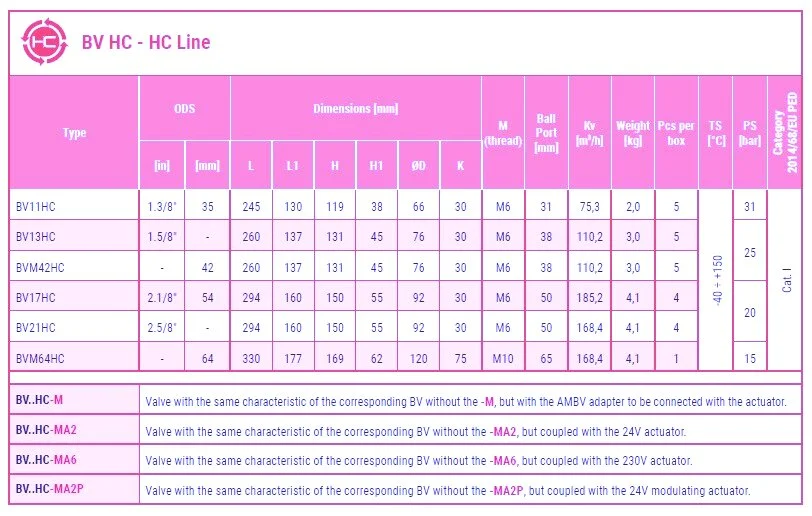
The entire product line is designed for use with hydrocarbon refrigerants (HC) available on the market — fluids classified under Article 13, paragraph 1 of PED Directive 2014/68/EU as Group 1. These refrigerants are listed in Annex E of EN 378‑1 as Class A3.
Compatible refrigerants include:
- HC: R290, R600, R600a, R1270
According to Table 1 of Annex II of PED Directive 2014/68/EU, all products are classified as Category I and must bear the CE mark, confirming conformity with the Directive.
All products also comply with STATUTORY INSTRUMENTS 2016 No. 1105 – Pressure Equipment (Safety) Regulations 2016, as amended by the Product Safety and Metrology etc. (EU Exit) Regulations 2019. Under this classification, all products are designated Category I and must bear the UKCA mark, demonstrating that their design meets the requirements of the cited regulations.